


Glass and Metal Facade Manufacturing Market Size, CAGR, Trends and Forecast 2025–2033
- Rahul Pal
- Nov 21, 2025
- 4 min read

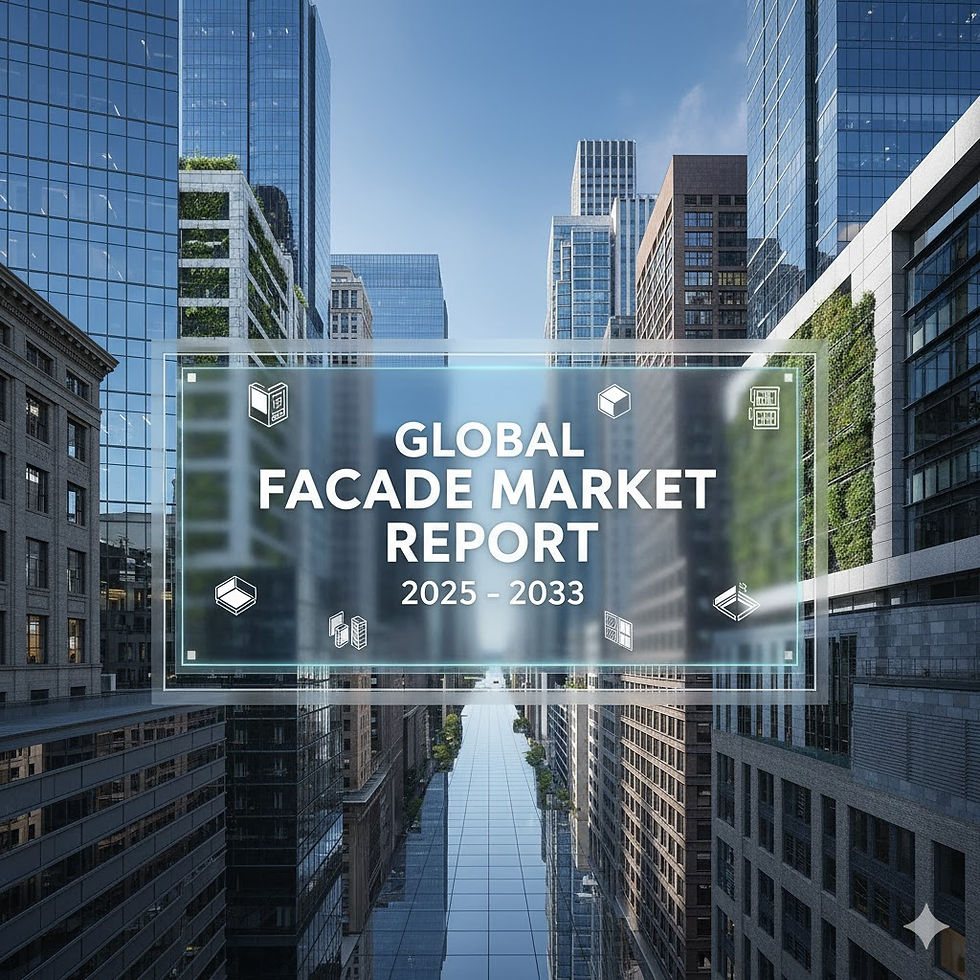
The global facade market size was USD 292.2 Billion in 2024 and is expected to reach USD 534.0 Billion by 2033, growing at a CAGR of 6.58% during 2025–2033. This growth is driven by rapid urbanization, infrastructural development, focus on sustainability and energy efficiency, strict regulations, technological advancements, and product innovation. Facades combine aesthetics with functionality and sustainability, involving materials such as glass, metal, and stones. The market is forecasted to expand notably driven by demand for energy-efficient and smart facade solutions.
Study Assumption Years
Base Year: 2024
Historical Year/Period: 2019-2024
Forecast Year/Period: 2025-2033
Facade Market Key Takeaways
Current Market Size: USD 292.2 Billion in 2024
CAGR: 6.58% (2025-2033)
Forecast Period: 2025-2033
Rapid urbanization and infrastructural development are major growth drivers.
Increasing focus on sustainability and energy efficiency leads to demand for eco-friendly facades.
Technological advancements include smart facades and building-integrated photovoltaics.
Ventilated facades dominate the market due to their energy efficiency and fire resistance.
Commercial end use is the largest segment, driven by branding and environmental sustainability.
North America holds the largest market share due to stringent energy regulations and green building codes.
Sample Request Link:
Market Growth Factors
Urbanization and Infrastructural Development
The global facade market is primarily propelled by accelerating urbanization and associated infrastructural development worldwide. As cities expand, there is an increasing need for diverse construction projects, including residential, commercial, and industrial buildings as well as public infrastructure such as hospitals, schools, and government buildings. Facades are essential for enhancing the aesthetic appeal, creating architectural identities, and protecting structures from environmental factors like wind, rain, and heat. Furthermore, facades help regulate indoor temperatures, contributing to energy efficiency and sustainability, thereby significantly expanding market demand.
Increasing Focus on Sustainability and Energy Efficiency
Environmental awareness and sustainability concerns are reshaping the construction industry, fostering demand for functional yet environmentally responsible buildings. Governments globally are enforcing stricter regulations to curb building-related carbon emissions, thereby necessitating energy-efficient facade solutions. Facades that moderate interior temperatures reduce the need for artificial heating or cooling, thus cutting energy consumption. Additionally, facades incorporating thermally active systems and bio-based materials further aid in minimizing carbon footprints, supporting the sector’s robust growth.
Significant Technological Advancements
Continuous technological innovations have given rise to smart facades featuring functionalities such as self-cleaning surfaces, dynamic glass that adjusts transparency based on light, and integration of digital technologies for interactive purposes. Moreover, embedding photovoltaic cells allows buildings to harvest solar energy, promoting sustainability. The incorporation of Internet of Things (IoT) devices and sensors enables real-time monitoring and control of facade operations, enhancing energy management and occupant comfort, thereby propelling market expansion.
Market Segmentation
Breakup by Product Type
Ventilated: Ventilated facades are the largest segment, valued for enhancing building functionality and aesthetics by regulating interior microclimate, reducing HVAC reliance, providing sound insulation, fire resistance, and offering easy maintenance.
Non-Ventilated: Not provided in source.
Others: Not provided in source.
Breakup by Material
Glass: Widely used in commercial and high-rise buildings for natural lighting and thermal insulation, the segment benefits from demand for energy-efficient, visually appealing solutions.
Metal: Includes aluminum and steel, favored for durability, low maintenance, weather resistance, and recyclability.
Plastic and Fiber: Gaining popularity in residential and low-rise commercial buildings due to lightweight and cost-effectiveness, balancing durability and design flexibility.
Stones: Used mainly in luxury residences and historic renovations, offering timeless aesthetics and long durability.
Others: Includes wood and composite materials, serving specific aesthetic or functional needs, less common in commercial buildings.
Breakup by End Use
Commercial: The largest segment, driven by corporate focus on brand image, architectural uniqueness, environmental sustainability, cost savings via smart facades, and improved worker well-being.
Residential: Not provided in source.
Industrial: Not provided in source.
Regional Insights
North America leads the global facade market, supported by the largest market share. Demand is driven by strict energy regulations, green building codes, favorable governmental incentives like tax rebates, and robust economic growth fueling commercial and residential developments. Aging infrastructure creates opportunities for renovation and retrofitting, while societal awareness of environmental issues and aesthetic preferences further boosts adoption. North America’s technology sector fosters higher uptake of smart facades integrated with advanced features.
Recent Developments & News
July 2021: Rockwool North America began commercial production of stone wool insulation at a new 460,000-square-foot facility in West Virginia using advanced melting and emissions technologies.
September 2022: Saint-Gobain acquired a minority stake in Megasol’s BIPV unit in Switzerland, expanding its sustainable facade solutions and leadership in BIPV facades in Europe.
January 2023: Enclos acquired PFEIFER Structures America, enhancing offerings with custom tensile membrane structures, structural glass systems, and kinetic structures.
Key Players
Compagnie de Saint-Gobain S.A
Enclos Corp. (CH Holdings USA Inc.)
EOS Framing Limited
FunderMax GmbH
Harmon Inc. (Apogee Enterprises Inc.)
Kawneer Company Inc. (Arconic Corporation)
Permasteelisa S.p.A. (Lixil Group Corporation)
Rockwool International A/S
Walters & Wolf Glass Company
YKK AP Inc. (YKK Corporation)
Get a Custom Market Research Report for Your Business:
If you require any specific information that is not covered currently within the scope of the report, we will provide the same as a part of the customization.
About Us
IMARC Group is a global management consulting firm that helps the world’s most ambitious changemakers to create a lasting impact. The company provide a comprehensive suite of market entry and expansion services. IMARC offerings include thorough market assessment, feasibility studies, company incorporation assistance, factory setup support, regulatory approvals and licensing navigation, branding, marketing and sales strategies, competitive landscape and benchmarking analyses, pricing and cost research, and procurement research.
Contact Us
IMARC Group,
134 N 4th St. Brooklyn, NY 11249, USA,
Email: sales@imarcgroup.com,
Tel No: (D) +91 120 433 0800,
United States: +1-201971-6302


Comments